Upkeep routines
Upkeep routines run recurring repository maintenance — broken links, failing Renovate pull requests, documentation drift, unreachable code, flaky tests, and duplicated helpers — inside hard spend, open pull-request, and yield boundaries.
Every routine stays inert until you explicitly bind it on a Repository under spec.routines[]. Upkeep never auto-merges on its own: automatic merges still require a live merge policy.
How routines stay bounded
| Guardrail | Behavior |
|---|---|
| Explicit opt-in | Unbound Routine definitions never schedule or trigger runs |
| Isolated upkeep budget | Charged against budgets.upkeepDailyUSD (independent of human and interactive budgets) |
| Open PR cap and cooldown | Skips a slot when maxOpenPRs is reached or inside cooldown (open_cap, cooldown) |
| Zero-token probes | dead-links, renovate-red, and actions-findings probes check deterministically before spending model tokens |
| Progressive delivery modes | Start in propose (read-only issue) or draft (draft PR) before graduating to pr |
| Yield breaker | Trips half_open or paused when consecutive closes/failures cross thresholds or rolling merge rate drops |
Ceilings on Routine | A Repository binding can only tighten maxOpenPRs, maxCostUSD, cooldown, egress, and breaker bounds — widening is refused |
Starter catalog
The agent-factory Helm chart installs six starter Routine objects in the factory’s namespace (routines.catalog.enabled: true, labelled maku.ogenki.io/catalog):
| Routine | Probe | Workflow | Default ceilings | Requires |
|---|---|---|---|---|
dead-links | dead-links | quick | 1 open PR · $1/run · 24h | oracleClass |
renovate-red | renovate-red | standard | 1 open PR · $2/run · 24h | — |
doc-drift | none | standard | 1 open PR · $2/run · 24h | — |
dead-code | actions-findings | standard | 1 open PR · $2/run · 24h | probeWorkflow |
flaky-tests | actions-findings | standard | 1 open PR · $2/run · 24h | probeWorkflow |
dup-unifier | none | standard | 1 open PR · $2/run · 24h | — |
Adding a custom routine
Apply any Routine (maku.ogenki.io/v1alpha1) custom resource in the factory’s namespace. It appears immediately in /routines/catalog labelled custom:
apiVersion: maku.ogenki.io/v1alpha1
kind: Routine
metadata:
  name: license-headers
  namespace: agent-system
spec:
  description: "Ensure new source files carry the Apache-2.0 SPDX header."
  workflow: quick
  dataClass: public
  defaultPrompt: |
    Add the missing Apache-2.0 SPDX header to tracked source files reported below.
    If no file is missing a header, make no changes.
  probe:
    kind: actions-findings
    requireConsecutive: 2
    maxFindings: 5
  requires: [probeWorkflow]
  maxOpenPRs: 1
  maxCostUSD: 1
  cooldown: 24h
  protectedPaths:
    - '^\.github/agent-factory/'
  breaker:
    window: 10
    minSamples: 5
    minMergeRate: 0.25
    maxConsecutiveClosed: 3
    maxConsecutiveFailures: 3
To replace a shipped catalog routine with your own manifest, add its name to routines.catalog.exclude in the chart values.
Managing routines in the Web UI
Overview (/routines)
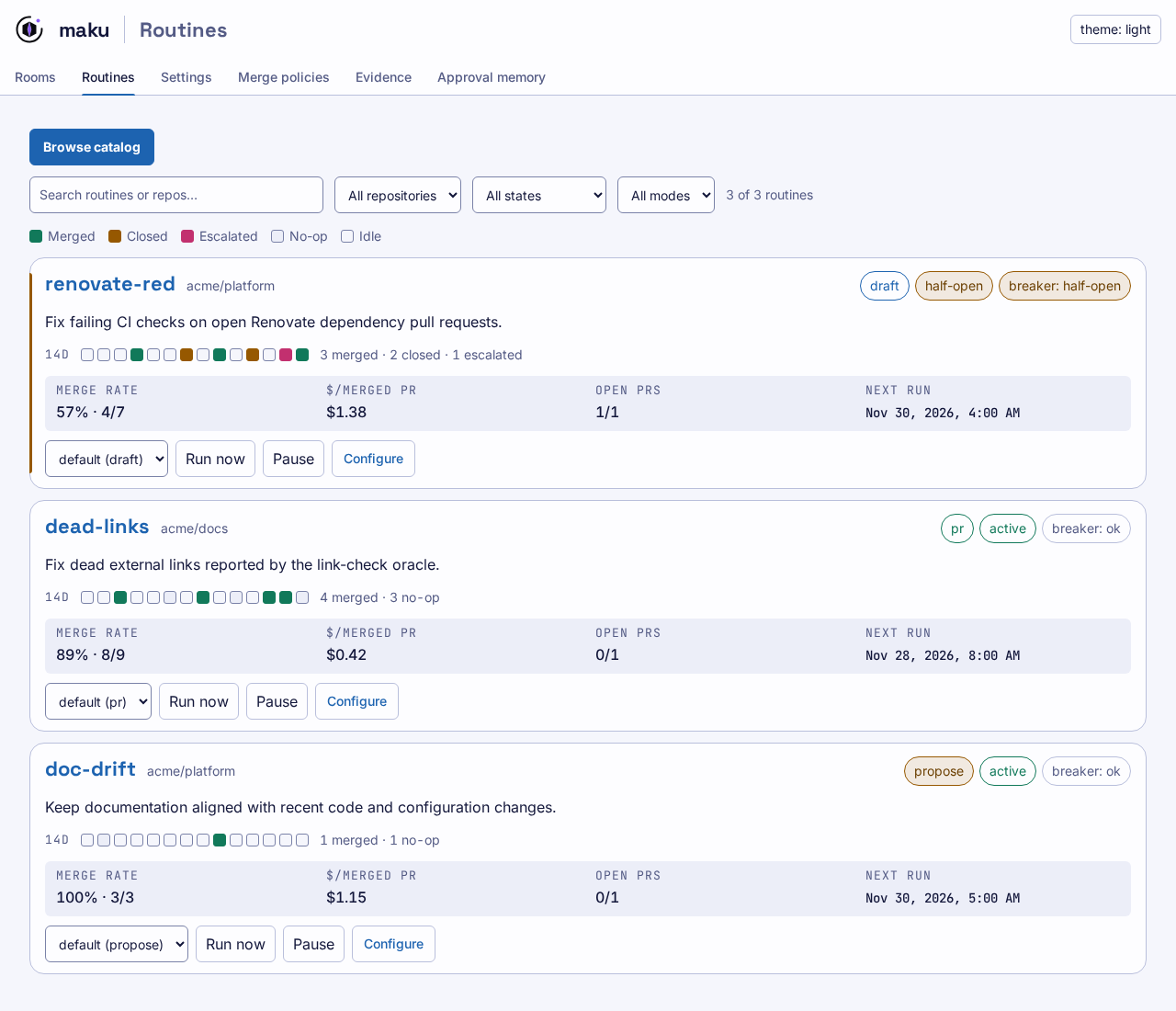
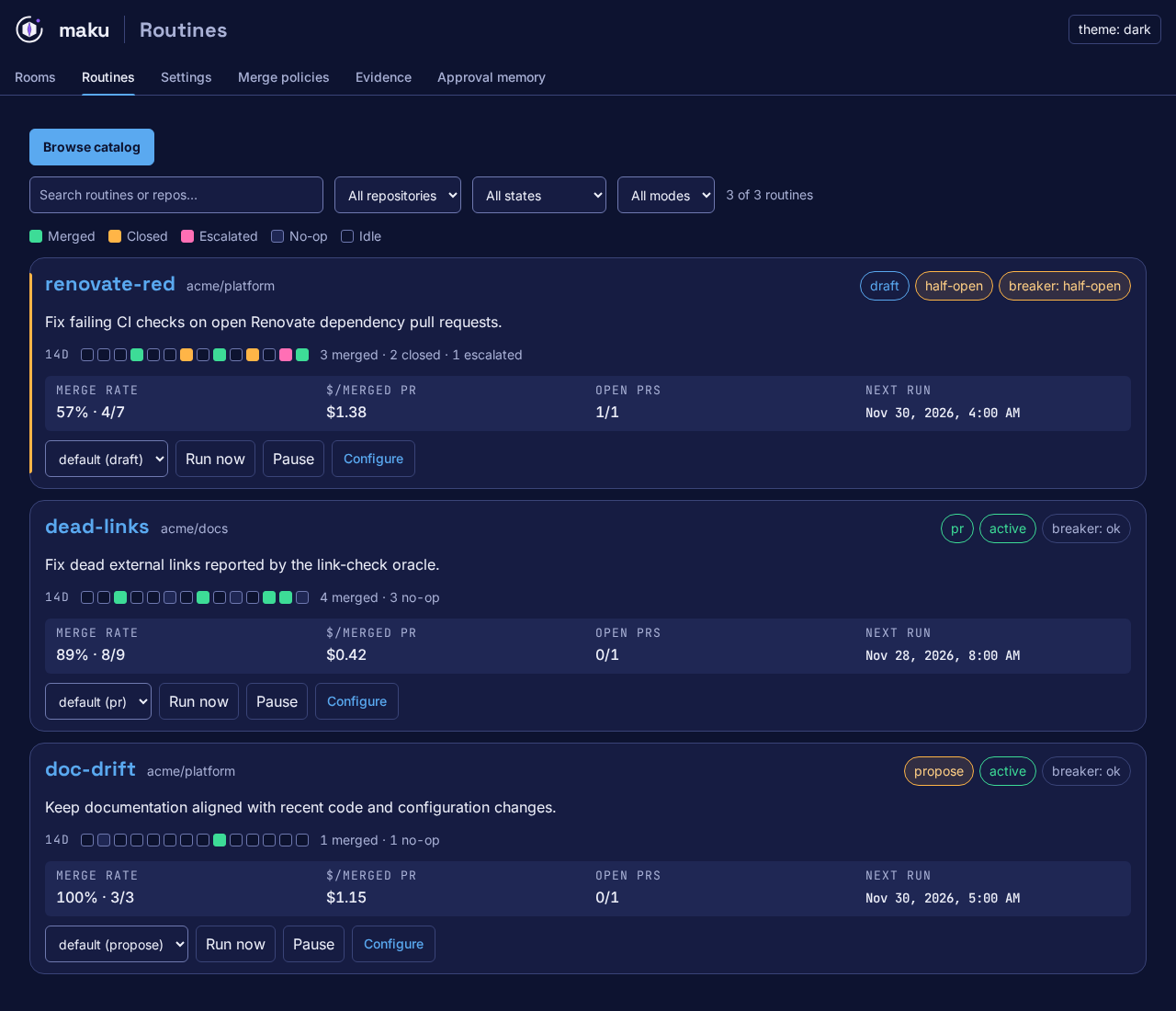
Monitor every bound routine across repositories you can read on GitHub. Cards sort attention items (paused, half-open) first and show 14-day outcome sparklines, rolling merge rate, $/merged, open PR count, and next UTC run. Maintainers with write access can override the mode and click Run now, Pause, Resume, or Configure.
Routine catalog (/routines/catalog)
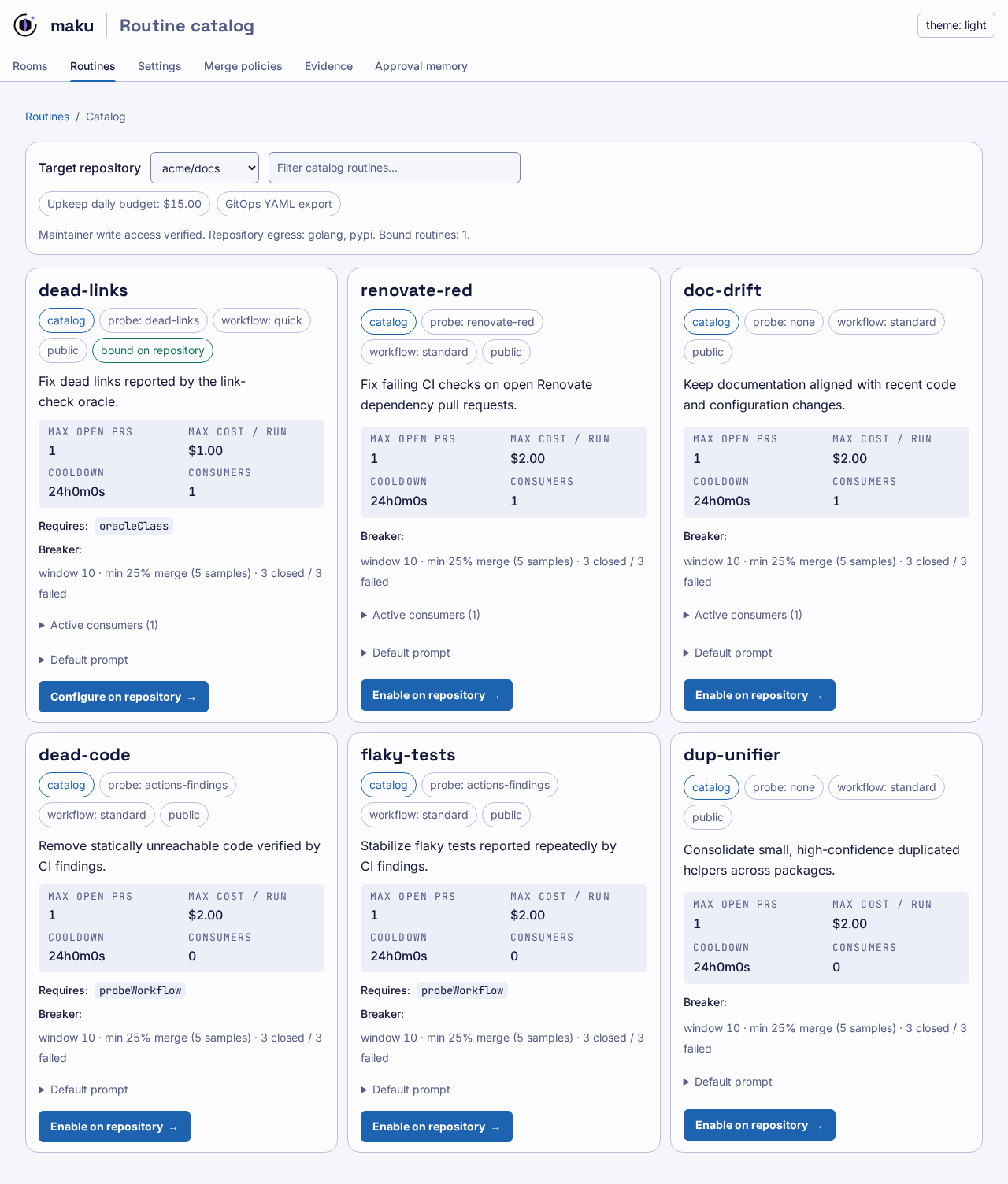
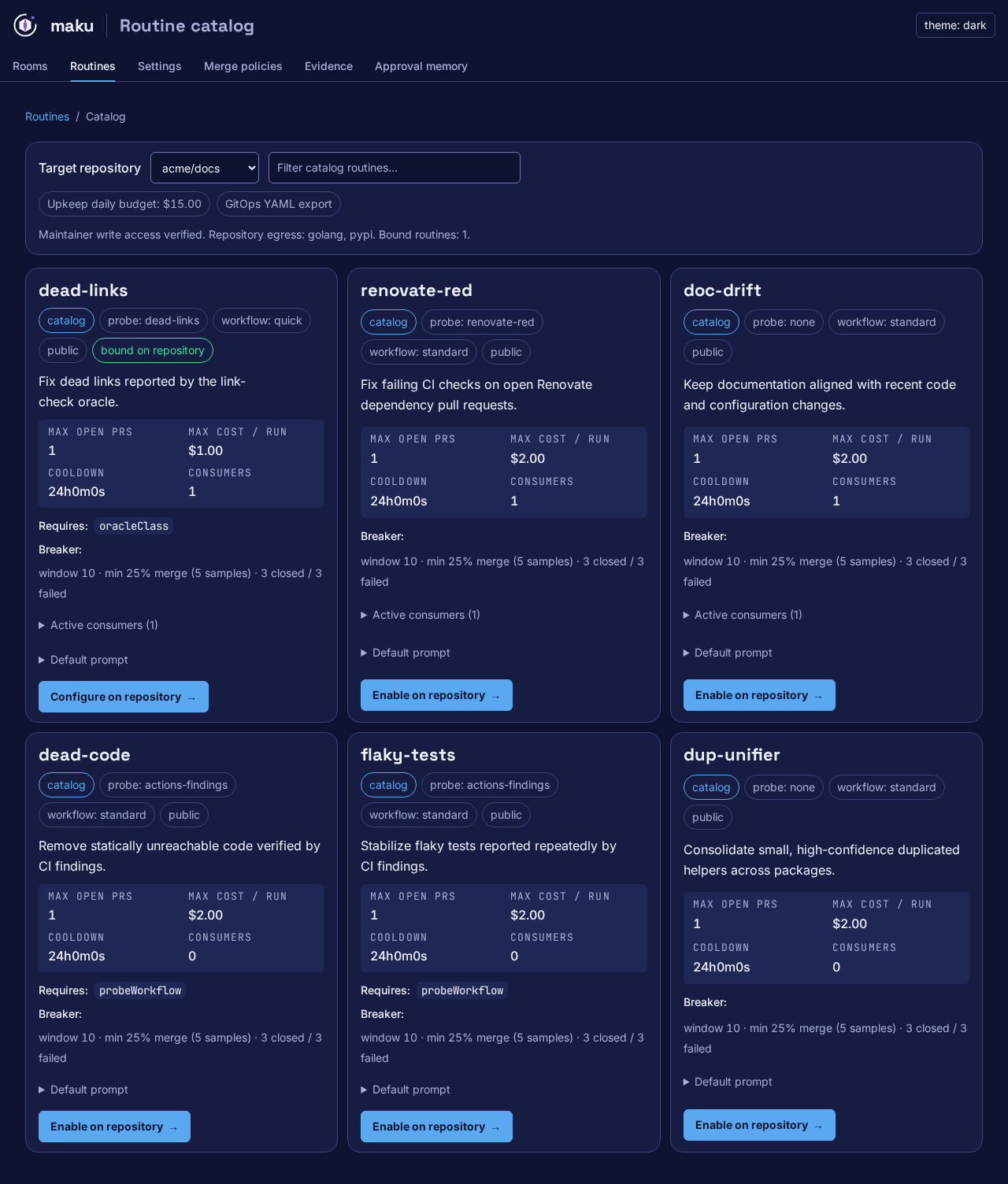
Browse shipped (catalog) and cluster-authored (custom) Routine definitions, pick a target repository, inspect ceilings and active consumers, and click Enable on repository → or Configure on repository →.
Guided configurator (/routines/<owner>/<repo>/<name>/edit)
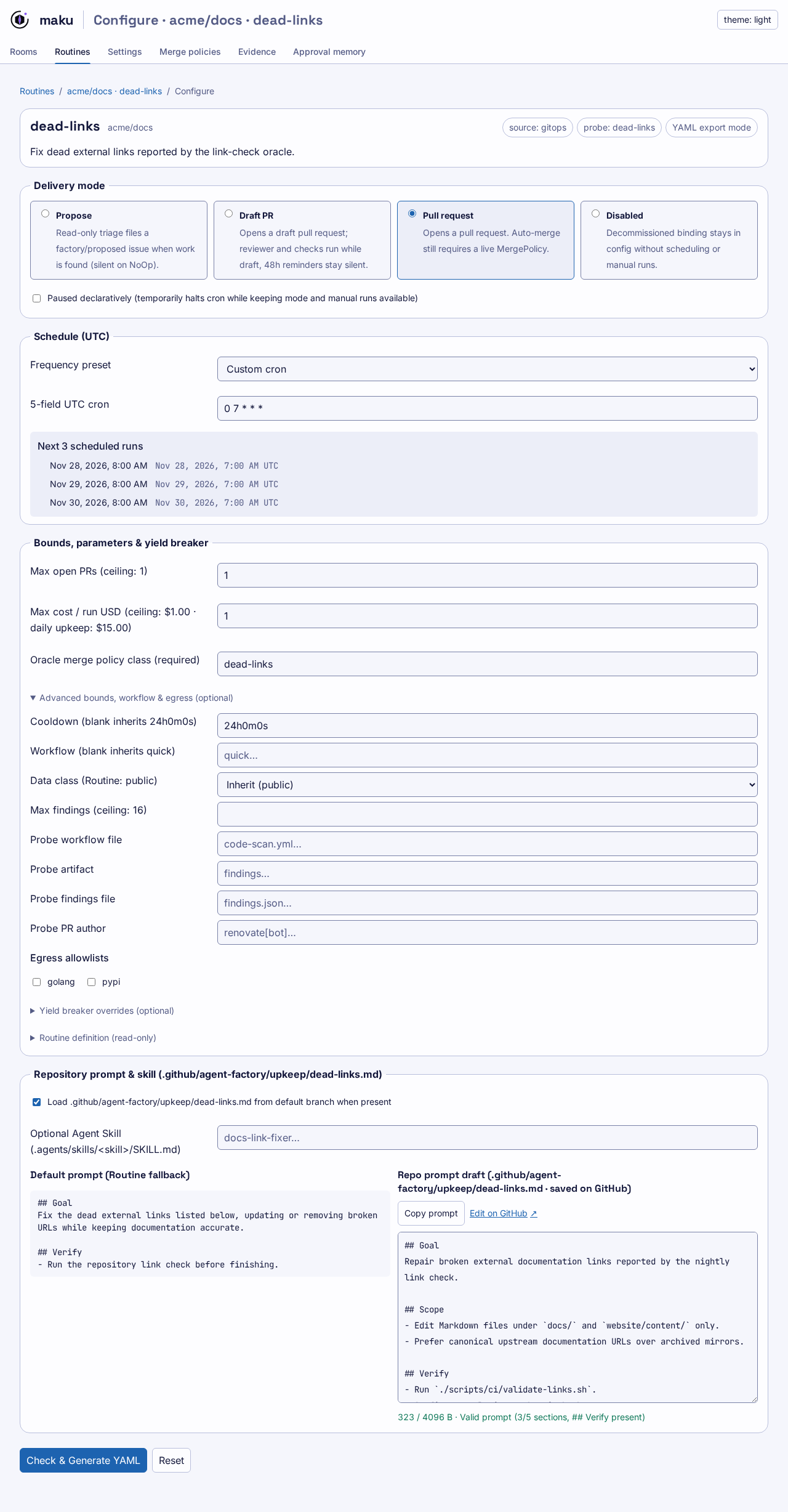
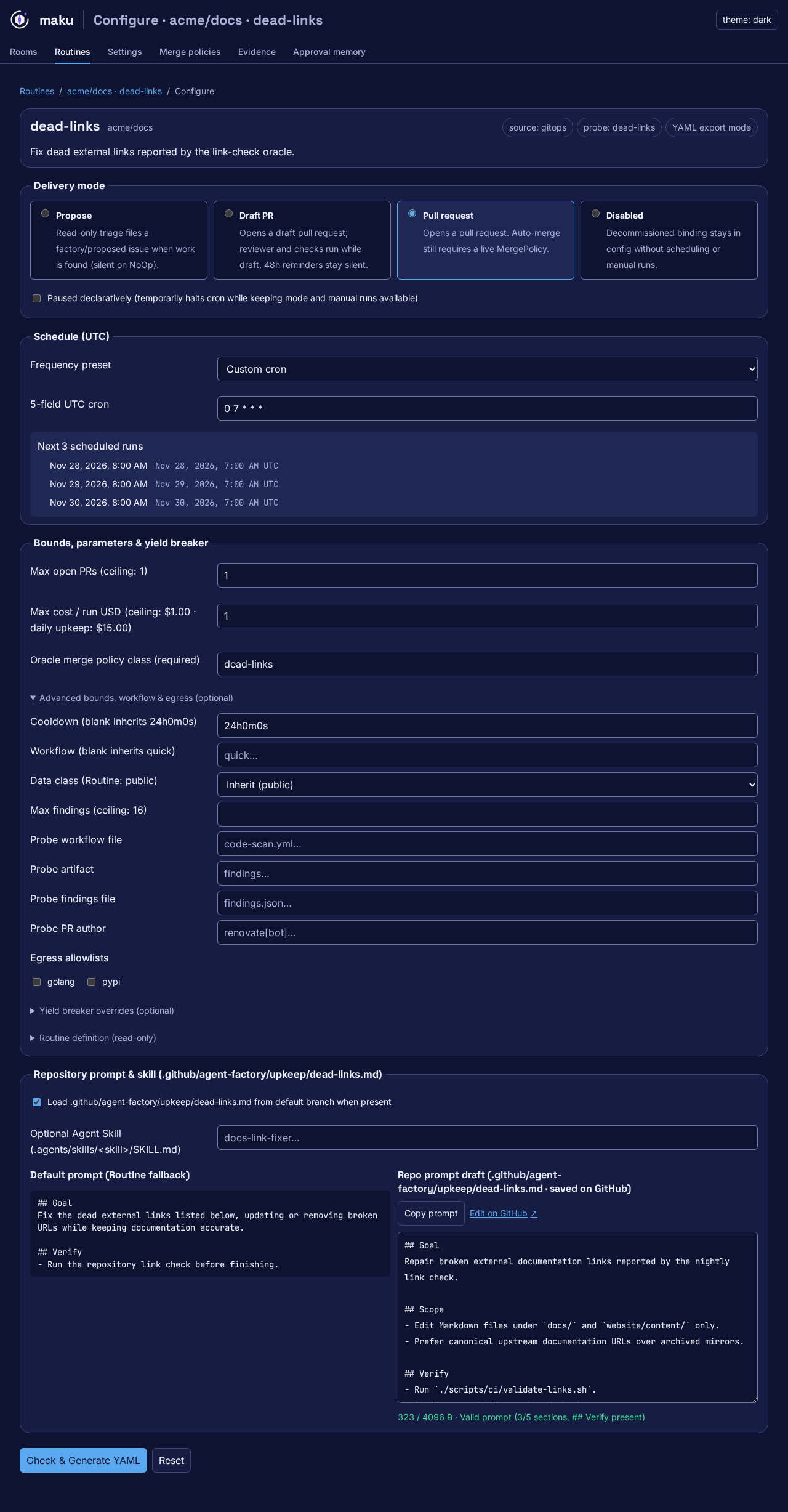
Configure delivery mode (propose, draft, pr, disabled), pick a UTC cron schedule with live local and UTC previews of the next three runs, adjust bounds inside the Routine ceilings, and author a repository prompt (.github/agent-factory/upkeep/<routine>.md) with live validation (<= 4096 bytes, <= 5 ## sections, a ## Verify checklist, and no control or invisible characters).
Click Check & Generate YAML to validate against the factory and copy or download repository-<name>.yaml for GitOps. When routines.uiWrite: true is enabled on the factory, Save to cluster persists UI-managed bindings into ConfigMap agent-factory-routine-bindings; GitOps-defined bindings stay read-only in the cluster (409 defined_twice).
CLI, prompts, and Slack
- CLI: run
maku routine list,maku routine run <owner/name> <routine> [--mode propose|draft|pr] [--dry-run],maku routine pause|resume <owner/name> <routine>, andmaku config export --routinesto export UI-stored bindings back to GitOps manifests (CLI reference). - Repository prompts and skills: commit
.github/agent-factory/upkeep/<routine>.mdon the default branch (repoPrompt: true) or pointskill:at.agents/skills/<skill>/SKILL.mdto tailor instructions without editing cluster manifests. - Slack upkeep channel and weekly digest: configure
upkeepChannelon maku-slack to route routine proposals, breaker trips, and weekly summaries (GET /api/routines/digest) to a dedicated channel.
Full field schemas, skip codes, and API contracts live in The factory, Web UI reference, and API reference.